Posts

Showing posts with the label art

19th Century Japanese Goofus and Gallant

Image
Were you a kid going to the dentists anytime in the 60s, 70s or 80s? I don't know what the connection is, but it seems that dentist's waiting rooms during that time were lousy with Highlights magazines. If you were lucky enough to be one of those kids whose regular oral hygiene checks included a significant stay in a magazine filled room then Goofus and Gallant may just be among your early memories of behavior models.  Pronounced Ga-LAHNT, because GAL-ent never occurred to me, the well-behaved twin modeled perfect behavior while Goofus - let's just say, did not. But creator, Dr. Gary Cleveland Myers, was not the first to use pictures of boys with contrasting behaviors to highlight good behavior. An earlier instance can be found in the work of Utigawa Kuniyoshi , a Master of ukiyo-e , who created the Moral Guidelines for Good and Naughty Apprentices  in the mid 1800s. This shows a good apprentice doing his master's errands, while the bad apprentices are harassin...

Fire Red and Gold

Image
As I work my way back into the everyday life this morning, I wanted to share this stunning serigraph from Eyvind Earle that captures autumn. While I didn't see anything this spectacular, his use of color and shapes evokes the memories of a great, extended weekend - half with friends and half with my honey.

A Sense of History: The Lansdowne Portrait

Image
Our kind friend, Mr. Carroll, has come to hasten my departure, and is in a very bad humor with me because I insist on waiting until the large picture of   Gen. Washington   is secured, and it requires to be unscrewed from the wall. This process was found too tedious for these perilous moments; I have ordered the frame to be broken, and the canvass taken out it is done, and the precious portrait placed in the hands of two gentlemen of New York, for safe keeping. And now, dear sister, I must leave this house, or the retreating army will make me a prisoner in it, by filling up the road I am directed to take. When I shall again write you, or where I shall be tomorrow, I cannot tell!! Dolley Madison to her sister, August 23 rd /24 th , 1814 George Washington, by Gilbert Stuart 1796 More on the primary source document can be found  here . A detailed study of the portrait can be found  here .

Looking for Art

Image
Which way is the art? How about this way? Have you seen the art?  No, not folk art. Aaah. Mr. Washington leads the way. The portrait of Mr. Lyon tells one of my favorite stories. William Morris Hunt seems to underpaint. I really like the effect. Mary Cassatt John White Alexander  A few John Singer Sargent favorites. Ikebana boat full of colorful dimensional glass pieces. Mille Fiore by Chihuly Neodymium Reeds There's something about a large art installation that almost always grabs my attention. Add dramatic lighting and it's rather atmospheric.  I'm not sure what these abstract pieces mean, if anything, but the largeness of the work alone forces my transportation into its world rather than allowing me to wander into the painting or wonder what it would be like in the pose of the sculpture. 

Spring Morning in the Heart of the City

Image
Image as cropped in my datebook. As a child, I was little impressed with Manhattan more than as a really crowded place with a big, famous statue in the harbor. It wasn't until relatively recently that I have come to appreciate the history, the culture, the human achievement strewn wildly about the small island. One of my favorite places there is the Metropolitan Museum of Art . In addition to the vast collection of magnificent art, it offers an almost decadent amount of perfectly staged indoor space in which to imbibe in the art. While we didn't make it there on our most recent flash tour of NYC, I have a date book that weekly reminds me of both New York, and the MMA: New York New York The Metropolitan Museum of Art: An Art Book and Engagement Book 2011. Today, I'd like to share the image that accompanied last week's dates. I hope you enjoy this spring morning brought to you by Frederick Childe Hassam as much as I have. Spring Morning in the Heart of the Ci...

The Tennis Ball Oath

Image
No, I’m not confusing the Henry V reference of “ Tennis balls, my liege ” with the French Revolution’s Tennis Court Oath , but I did think of both when I saw this drawing. Photo of drawing found on Prints Old and Rare It’s called The Dog Congress (W. H. Beard, 1880), but its lighting and detail of individual faces so reminded me of The Tennis Court Oath (Jacques Louis David, 1789, below) and its subjects might so enjoy a good game of fetch, that I could not help but immediately think of it as the Tennis Ball Oath . Explore this sketch in greater detail here .

Dog Crossing

Image
Alea Jacta Est. This is what Julius Caesar is reported to have said as he crossed the River Rubicon at the head of his army and began the pursuit of Pompey, his rival in the Roman Senate, into Northern Italy. Literally translated it means, the die has been cast . Practically speaking, it means there is no turning back once this action has been taken. Here, the German artist, Wilhelm Truber , gives his version of Crossing the Rubicon ( 1878/79 ). Painting image found here .  I love how the painting captures the moment within which the dog may actually be considering its options and how the title perfectly reflects the import of that moment.  What kind of dog do you think this is?  It looks a lot line a Cane Corso to me - the cropped ears* particularly.  *This image is slightly different from the one I have in the book, Best in Show: The Dog in Art from the Rennaissance to Today , Yale University Press, 2006.  In that book, the dog is darker, its eyes ...

Dogs and Philosophers

Image
No doubt , Diogenes of Sinope (c. 412-323 BCE), Diogenes the Cynic , or Diogenes the Dog as he was sometimes known, was odd to say the least, preferring to live naturally on the streets emulating a dog, than to succumb to the hypocrisy of living by social norms. From Wikipedia : Many anecdotes of Diogenes refer to his dog-like behavior, and his praise of a dog's virtues. It is not known whether Diogenes was insulted with the epithet "doggish" and made a virtue of it, or whether he first took up the dog theme himself. The modern terms   cynic   and   cynical   derive from the Greek word kynikos, the adjective form of   kyon   (κύων), meaning dog.   Diogenes believed human beings live artificially and hypocritically and would do well to study the dog. Besides performing natural bodily functions in public without unease, a dog will eat anything, and make no fuss about where to sleep. Dogs live in the present without anxiety, and have no use for the pr...

Falling Gough: A Romance

Image
Sometime in 1805, a young man went out walking in the mountainous Lakes District in England with his dog. He never returned and no one looked for him. Three months later, a shepherd climbing through the same region heard barking and found the young man’s remains on a promontory, having clearly fallen to his death, still guarded by his faithful companion. That’s how the Romantic poets Sir Walter Scott and William Wordsworth both described the scene in 1806, and how Edwin Landseer painted it years later. While the truth of what happened to Charles Gough may have been far less romantic , it does not change the fact the Gough’s dog remained with his body for three months. Helvellyn By Sir Walter Scott (1771-1832)                            I climbed the dark brow of the mighty Helvellyn, Lakes and mountains beneath me gleamed misty and wide; All was s...

Leonbergers: Two Ways

Image
One of the new breeds of working dogs in the show this year is the Leonberger .   The name instantly brings to mind a big juicy patty of lion meat.   Okay, maybe that’s just me, but in researching the breed a little more, I found out two interesting ways to prepare the naming of a dog breed: promoting places and producing paintings. First, according to the AKC , Calm, gentle and sweet, the Leonberger excels as a multi-purpose working dog, but its most important task is being a reliable family companion. They are friendly dogs that are willing to please, making them excellent therapy dogs. Despite the breed’s lion-like looks and large size, the Leonberger is actually quite light on its feet and graceful in motion. They can be red, reddish brown, sandy, or yellow brown and may have a black mask. ****** The Leonberger originated in the 1800s in Leonberg, Germany. Their original purpose was to be a family, farm and draft dog. The breed caught the attention of popular German ...

Mum in the Kitchen

Image
During a recent trip to the MFA's new Art of the Americas wing, my youngest daughter briefly studied the 20th century painting, Matta's Circle of Wheat .  While she agreed with the experts when they said that, Cercle du Blé" explores a primordial landscape of violence and conflict; it teems with fantastical creatures and threatening implements rendered in pulsating color, she insisted on changing its name to better reflect that violence and conflict.  It was only upon her renaming of it that I began to truly appreciate the piece, Mum in the Kitchen. If you go, don't avoid the third floor ( gallery of the 20th century ); there are some terrific paintings (I like  Sheeler ), cool photographs (id.), and a few pieces of Eames furniture worth seeing.

Pun and Punctuation

Image
Recently, I came across this fascinating Magritte-esque image in my book, The Dog: 5000 Years of the Dog in Art . It’s a little play on the French words for au petit chien (to the little dog)= opticien.   Get it?   Okay, it’s not so punny, but it was rather the artist that impressed me:  Jean-Leon Gerome! Gerome, whose major works can be found here , was a great painter in the Academic style and known for his historic and Orientalist works.   I knew him as the painter of images like these:    Pygmalion and Galatea Snake Charmer Pollice Verso So, does the first image, basically an advertisement, well outside of what I know to be his artistry, and reportedly admired by a young Dali, detract from his achievement? And what about Jane Austen ? In today’s Guardian , Jane was outed as having been a veritable libertine with dashes!   Does this tarnish her literary genius? In both cases, I’m going to have to say,  nah . The incredibl...

Mr. Gotch, Mr. Thayer, and Mr. Bourque

Image
They may sound like a trio of barristers come to help secure your fortunes against greedy relatives as you lay dying in the opulent bed chamber of your manner home, but they are something far more important according to my daughter; well, at least two of them are.   It is her dearest hope that the last will join the ranks of Mr. Gotch and Mr. Thayer in making his daughter the obvious model for some striking, timeless paintings. While she was touched by the daughter-as-subject bug long ago when my husband used our other daughter as a model for his sketched study of Persephone (for a painting that was never to be), her interest was recently renewed when she came upon this painting in her book, Sound the Deep Waters : Women’s Romantic Poetry in the Victorian Age.    The Child Enthroned , Thomas Cooper Gotch, 1894 Clearly, she could not be certain from the image alone that the model used here was Gotch’s daughter. But something about the image rang familiar with her ...

A Little Modern Art Humor

Image
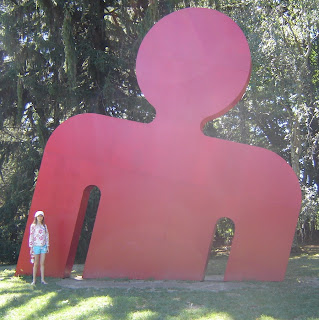
Guess the name of this red steel piece  at the deCordova Sculpture Park. No matter how much I dislike modern art, I find that I am always delighted to be in the beautiful outdoor sculpture park at the deCordova Museum in Lincoln.  My youngest and I spent several hours there yesterday, making a brief tour of the new art, revisting our old favorites, talking about what art is, and spending a long time under the trees reading our books.  It was wonderful.